ATPL(H) :: Course Inclusions

Course Inclusions

Navigation (ANAV) – Distance Learning and Full-time Ground School options

Study Material Included:

  • AFT Navigation Theory Notes, Revision Tests, Answers and Workings
  • AFT Navigation Practical Notes, Revision Tests, Answers and Workings
  • AFT Navigation Additional Revision Tests, Answers and Workings
  • AFT ANAV Practice CyberExams with 8 Standard Marking Credits
  • AFT ANAV Practice CyberExam Answers and Workings

Aerodynamics and Aircraft Systems (AASH) – Distance Learning and Full-time Ground School options

Study Material Included:

  • AFT Basic Gas Turbine Notes, Revision Tests and Answers
  • AFT Aerodynamics Notes, Revision Tests and Answers
  • AFT Aircraft System Notes, Revision Tests and Answers
  • AFT Automatic Fight, Flight Management and SAS Notes
  • AFT Supplementary Systems Notes
  • AFT Inertial Navigation Notes
  • AFT AASH Practice CyberExams with 8 Premium Marking Credits
  • AFT AASH Practice CyberExam Answers and Workings

Flight Planning (AFPH) – Distance Learning Only

Study Material Included:

  • AFT Flight Planning Course Notes and Revision Tests
  • AFT Flight Planning Course Notes Answers and Workings
  • AFT APLH Practice CyberExams with 8 Premium Marking Credits
  • AFT AFPH CyberExam Answers and Workings
  • Access to AFT’s AFPH Random Question Generator System

Performance and Loading (APLH) – Distance Learning Only

*  Before attempting the ATPL(H) Performance and Loading course, it is recommended that you complete the ATPL(H) Flight Planning course. The ATPL(H) Performance and Loading course has been written assuming you have a good understanding of ATPL(H) Flight Planning and a basic understanding of company fuel policy.

Study Material Included:

  • AFT Performance and Loading Notes and Revision Tests
  • AFT Performance and Loading Notes and Revision Test Answers and Workings
  • AFT APLH Practice CyberExams with 8 Premium Marking Credits
  • AFT APLH CyberExam Answers and Workings
  • Access to AFT’s AFPH Random Question Generator System
  • AFT Weight and Balance Load Sheets
  • Part 133 of CASR and MOS
  • CASA Advisory Circular AC 133-01 V4.2 Performance Class Ops

Meteorology (AMET) – Distance Learning Only

Study Material Included:

  • AFT Meteorology Notes, Revision Tests and Answers
  • AFT Upper Level Meteorology Notes, Revision Tests and Answers
  • AFT Meteorology Additional Revision Tests and Answers
  • Bureau of Meteorology – Manual of Aviation Meteorology Textbook
  • AFT AMET Practice CyberExams with 8 Standard Marking Credits
  • AFT AMET Practice CyberExam Answers

Air Law (AALW) – Distance Learning Only

Study Material Included:

  • AFT Air Law Notes and Revision Tests
  • AFT Air Law Notes and Revision Tests Answers with References
  • CASA Plain English Guide
  • AFT AALW Practice CyberExams with 8 Standard Marking Credits
  • AFT AALW Practice CyberExam Answers with References

Human Factors (AHUF) – Distance Learning Only

Study Material Included:

  • Bob Tait Human Performance and Limitations Notes
  • AFT Human Factors Supplementary Notes
  • AFT Human Factors Supplementary Notes Answers
  • Tony Wilson – Human Performance and Limitations Textbook
  • AFT Threat and Error Management Notes
  • AFT AHUF Practice CyberExams with 8 Standard Marking Credits
  • AFT AHUF Practice CyberExam Answers


ATPL(H) :: Full-Time Ground School (ANAV & AASH)

Course Outline

We offer a Full-Time Ground School course for ATPL Navigation and ATPL Helicopter Aerodynamics and Aircraft Systems. The remaining five subjects can be completed by our Distance Learning course.

Navigation is a generic subject between both ATPL Helicopter and Aeroplane. Aerodynamics and Aircraft Systems is 80% the same content for both ATPL Helicopter and Aeroplane. Since the majority of the Syllabus is common between the two and has a large focus on Aeroplanes, we find Helicopter pilots do benefit in coming along to the Full-Time Ground School course for these two subjects.

The ATPL(H) Theory Course for Navigation and Aerodynamics and Aircraft Systems consists of 3 weeks intensive full-time study, working from 8.00am to 5.00pm, Monday to Friday. You will also be expected to do homework each night and over the weekend.

Navigation (ANAV)

Study Material Included:

  • AFT Navigation Theory Notes, Revision Tests, Answers and Workings
  • AFT Navigation Practical Notes, Revision Tests, Answers and Workings
  • AFT Navigation Additional Revision Tests, Answers and Workings
  • AFT ANAV Practice CyberExams with 8 Standard Marking Credits
  • AFT ANAV Practice CyberExam Answers and Workings

ANAV Full-time Ground School Outline

Navigation commences on Monday, with six days spent in the classroom and the CASA ANAV PEXO Exam scheduled for the Tuesday after class finishes.

Navigation includes studying the static/pitot system, gyroscopic/laser ring instruments, weather radar, radar/radio altimeters and the latest on GPS. The principles of operation of radio navigation aids and their errors and limitations, determining position by way of radio navaid information (RMI with VOR/ADF) and the use of an ERC are covered next. You will learn to plot Critical Points and the Point of Safe Diversion on ERC and how to calculate track intercepts without a chart using basic trigonometry. The subject material is covered in the classroom from Monday to Friday, with Practice CyberExams over the weekend and the Monday before the CASA ANAV PEXO Exam on the Tuesday.

Aerodynamics and Aircraft Systems (AASH)

Study Material Included:

  • AFT Basic Gas Turbine Notes, Revision Tests and Answers
  • AFT Aerodynamics Notes, Revision Tests and Answers
  • AFT Aircraft System Notes, Revision Tests and Answers
  • AFT Automatic Fight, Flight Management and SAS Notes
  • AFT Supplementary Systems Notes
  • AFT Inertial Navigation Notes
  • AFT AASH Practice CyberExams with 8 Premium Marking Credits
  • AFT AASH Practice CyberExam Answers and Workings

AASH Full-time Ground School Outline

Aerodynamics and Aircraft Systems commences on a Wednesday, with seven days spent in the classroom and the CASA AASH Exam scheduled for the Friday after class finishes.

The Aerodynamics and Aircraft Systems syllabus is very broad, covering BGT (Basic Gas Turbines), EFIS (Electronic Flight Instrument Systems), FMS (Flight Management Systems) and all aircraft navigation and control systems. These are all discussed in great detail. Special videos on many of the important aspects will be viewed. Aircraft Hydraulic and Electrical Systems are also topics covered during the course.

Advanced Flight Theory has an EFIS Computer Simulator, displayed via large screens. The simulator allows us to show, in real time, a complete flight using the latest in EFIS displays and FMS. Wednesday to the following Thursday are spent learning the subject material, with Practice CyberExams sat on Thursday before the CASA AASH Exam.

While time spent in class is intensive, our course format allows as much time as possible for many detailed revision tests. On completion of each subject module you can attempt Advanced Flight Theory’s Practice CyberExams before attempting the CASA Exams.

Our fees include all Course Notes, Revision Tests, Practice CyberExams and Answer Sheets. There is no requirement to purchase any other textbooks as all relevant references and manuals are included. You will however need to provide your own set of Airservices Publications, Charts and Navigation Equipment.

The remaining five ATPL(H) subjects are:

  • Flight Planning
  • Performance and Loading
  • Meteorology
  • Air Law
  • Human Factors

The Distance Learning subjects can be completed at your convenience, before or after attending the ATPL ground school. The package covers the entire CASA Part 61 Manual of Standards Aeronautical Knowledge Standards (Syllabus) includes comprehensive Notes, Revision Tests, Practice CyberExams and Answer Sheets. Many students have received 100% for these subjects after using our study material only and making the effort to study hard.


ATPL(H) :: CASA Exam Information

CASA Examination Information

There is a considerable amount of information regarding the CASA Exam system available on CASA’s ATPL Exams Page

7 Subject ATPL Examination

The ATPL examination is made up of seven separate examinations. These are:

  • Flight Planning
  • Navigation
  • Performance and Loading
  • Aerodynamics and Aircraft Systems
  • Human Factors
  • Meteorology
  • Air Law

Individual Subject Credits

All ATPL exams are individual examinations. Candidates may choose to sit any number of papers at any particular sitting and be credited with a pass in each examination separately. When all subjects have been passed, a candidate is awarded a pass in the ATPL examination.

Examination Pre-Requisites

The pre-qualification requirements for the ATPL is a pass in the Australian CPL(H) theory examination or a CPL(H) Licence. You will be unable to book an examination unless you meet this requirement.

In particular, overseas students should note that they must hold a CASA CPL(H) or have a pass in all seven parts of the CASA CPL(H) theory exam to meet pre requisite qualifications for sitting CASA ATPL(H) Exams. It is essential for overseas students to contact the CASA Flight Crew Examination and/or Licencing Sections to confirm they meet this requirement prior to booking their CASA ATPL examinations.

Perpetual Validity Period

The ATPL credit once issued, will remain valid indefinitely. This may be reviewed at a later date.

Two Year Time Frame

As of 1 September, 2014 a candidate has two years to pass all seven ATPL examinations to be awarded an ATPL theory pass. More information can be found on CASA’s website under ‘Re-training periods and exam windows’.

Pass Mark Required

The pass mark for each CASA examination is 70%, except for the Air Law where the pass mark is 80%.

Exam Fees

ASPEQ has a contract for the nationwide delivery of Flight Crew licensing examinations for the Civil Aviation Safety Authority (CASA). ASPEQ is responsible for the booking and delivery of the examinations through a network of examination sites, while CASA is responsible for the provisions of the examinations through their PEXO Exam System.

The fees for the examination service is split into two parts –

  • CASA Examination Fee
  • ASPEQ Examination Delivery Fee

Examination Venues

CASA Exams can be sat at many CASA authorised exam centres Australia wide.

Booking your CASA/ASPEQ Exams

All CASA Flight Crew Licencing Exams are to be booked through ASPEQ’s website.

There are two parts to the ATPL Examination fees – a CASA fee and an ASPEQ fee.

The CASA examination fees are for the PEXO Exam service provided by CASA via their web-based delivery system. The ASPEQ exam delivery fees are charged for each examination subject required. The fee structure is based around the length of the examination subject as this determines the amount of computer time used to deliver the subject. Please see CASA’s website for current exam fee information for AFPH, APLH and AASH or AALW, AHUF, ANAV and AMET.

IMPORTANT NOTE: CASA and ASPEQ fees are NOT included in our course fees for Full Time Ground School or Distance Learning Courses. If you are attending our Full Time Ground School Classes we have pre-booked CASA Exam sessions for our students at the end of each subject. If requested, we can book your exam in one of these sessions for you on your first day in class and charge the exams fees to your account. Our pre booked sessions mean you do not need to book your own CASA Exams for subjects you do in class with us. You must book your own CASA Exams for any Distance Learning subjects you study.

Before booking any CASA Exams candidates need to be sure of their eligibility and timing before making a booking.


ATPL(H) :: Additional Items Required for Study and Exam

ATPL Helicopter – Things You Need

To complete our ATPL(H) Course, you will need to ensure you have all the material needed to complete your study and most importantly, sit your CASA examinations. For a full list of what you need to complete the ATPL exams, please see CASA’s  Permitted Material allowed to be taken into Examinations under Part 61.

You need to have the current edition of the following documents to complete the ATPL(H) CASA PEXO Exams: 

  • AIP Complete
  • ERSA with RDS
  • All ERC High Charts
  • All ERC Low Charts
  • PCA Chart
  • S76 Performance and Operations Handbook (provided by AFT)
  • Part 133 of CASR (provided by AFT)
  • Part 133 MOS (provided by AFT)
  • CASA Advisory Circular AC 133-01 V4.2 Performance Class Ops (provided by AFT)
  • Navigation equipment
  • A basic calculator
  • CAR 1988*
  • Part 61 of CASR*
  • Part 91 of CASR*
  • Part 91 MOS*
  • Part 121 of CASR*
  • Part 121 MOS*
  • Part 135 of CASR*
  • Part 135 MOS*
  • CAO 48.1 Instrument 2019*

The CASA Regulatory Documents are not included in your Full Time Ground School or Distance Learning Course fee and can be purchased separately through our online Pilot Supply Shop.

* These documents can be purchased in our AALW Air Law Document Package, which includes the following printed CASA Documents Permitted Material which has been extracted specifically for the ATPL Air Law Examination by Warren McIvor and Nathan Higgins. Printed in 2 Binders.

    If you are attending a Full Time Ground School course (for Navigation or Aerodynamics and Aircraft Systems), all of these items can be purchased from our pilot supply shop on the first day of your course, so you do not need to worry about obtaining them before you arrive.

    To see the current pricelist and place your order, please visit our online Pilot Supply Shop.

    Important Note: Departure and Approach Procedures (DAP) East and West is a permitted reference for the CASA Air Law PEXO Exam, however the main topic covered by the Air Law syllabus that requires reference to DAP East and West is noise curfew procedures and requirements. If you do not already have DAP East and West and wish to avoid the considerable cost of purchasing these documents, you should familiarise yourself with noise curfew procedures before sitting the CASA Air Law PEXO Exam.


    From Country Roads to Ocean Views

    When Karl Mayne sat in our CPL(H) classroom back in 2017, we never would have imagined that a few years later, that same flannelette-shirt-wearing country boy would return to the Sunshine Coast to launch the region’s premier helicopter tourism company – Oceanview Helicopters.

    Oceanview Helicopters is a family owned and operated business offering scenic flights, winery tours, aerial photography, charters, airwork and heli wedding packages. Operating from their base at Caloundra Airport, Karl and his team fly a fleet consisting of an R44 and R66, delivering unforgettable experiences across the coast.

    Karl’s vision for Oceanview Helicopters was simple: create extraordinary moments. Whether it’s a champagne sunset flight over Moreton Island, a unique heli pub crawl, trackside drop offs at the races, a go-kart or heli-golf adventure, or a romantic picnic atop a mountain peak – every experience is designed to be memorable.

    Today, that vision is a reality. “I have the best job in the world because my job brings everyone joy,” says Karl.

    A big thank you to Karl who also very kindly allows our CPL(H) Full-time Ground School students a tour of his hangar to get a hands on look at their machines. It is a fantastic opportunity for students to connect theory with practical knowledge and gain valuable hands on insight while they study.


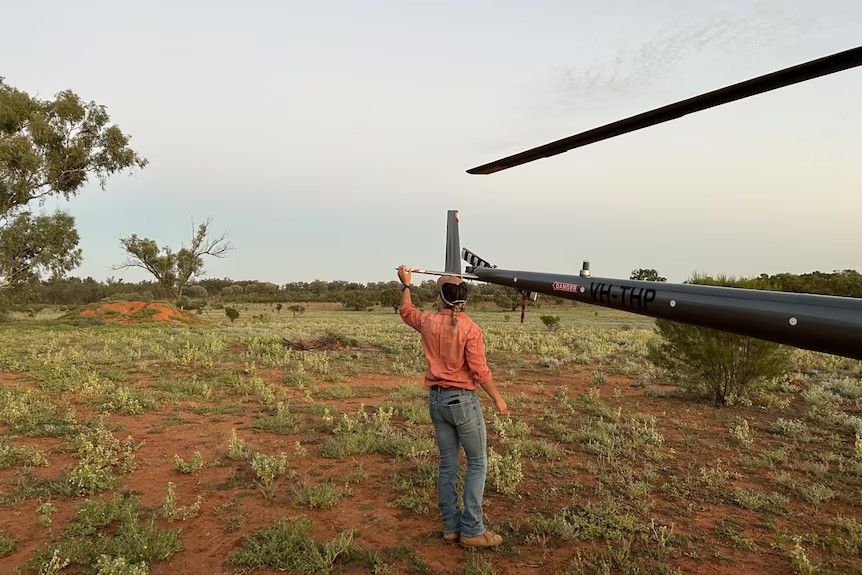
    Fly like a Girl… An AFT Student Success Story

    In 2023, Tash Greenfields completed her CPL(H) theory with us here at AFT. She has since gone on to land a dream mustering job.

    The following article was published by the ABC on 03rd March, 2024:

    Mustering stock, navigating the vast landscapes of outback Australia and directing “ground crew'” from above is all in a day’s work for Natasha “Tash” Greenshields.

    Tash is a helicopter mustering pilot.

    A dream job that, not too long ago, she thought was beyond her reach.

    Growing up on a cereal cropping farm before her family moved to Narraport Station, a sheep, cattle, and goat station in Far West New South Wales, the 25-year-old loves everything about living on the land.

    Tash has worked as a contract musterer, livestock pregnancy scanner and a working dog trainer.

    But ever since she got a bird’s eye view of the family farm from a helicopter, working the land from above has been her ultimate goal.

    “As a kid, I always dreamed of flying,” Tash said.

    “I would have been eight or nine … and I thought, ‘This is what I’m going to do.'”

    Helicopter mustering may seem like a simple task.

    But it’s a job that requires precision, skill, determination and, above all, guts.

    The pilots perform complex flying manoeuvres to locate and move stock, direct and provide instruction to the ground crew, who then must identify and muster the animals.

    This is all while ensuring you’re keeping the chopper safe.

    It’s not a job for the faint-hearted.

    Tash loves the “adrenaline rush” and “being in the air and working stock” but is also about the “simple things”.

    “It’s nice to see a team working together,” she said.

    “I get stoked seeing people working their dogs on the ground. I get like a proud mum, I think.”

    Self-doubt almost derails career

    Yet, Tash almost gave up on her dream of becoming a pilot.

    Self-doubt and a few negative comments, made her believe her goal was impossible.

    “I remember one comment was, ‘Why would you get your licence because you’ll be having kids and having a family?'” Tash said.

    “I thought that was a bit ridiculous.”

    But she said those comments really got to her.

    “I don’t know why, but I really took that on, and it made me change my mind,” she said.

    “I didn’t really think I’d be able to achieve that goal.”

    The cost of a commercial helicopter licence was also a major hindrance.

    Participants can be left between $50,000 to $90,000 out of pocket, creating a barrier for those wanting to enter the industry.

    “The cost is a massive thing. It’s a big outlay for a chance at flying,” she said.

    “Just having that doubt … ‘If I get my license, what am I going to do if I don’t have a machine to fly in?'”

    The opportunity of a lifetime

    Louis Bennell, co-owner and chief helicopter mustering pilot at Far West Helico, met Tash while working on her family’s station.

    It was here that a conversation between Louis and Tash’s parents led to Tash realising her dream.

    “Tanya and Andrew mentioned that Tash had always wanted to fly, something I hadn’t known up until that point,” Louis said.

    “Without even thinking, I blurted out, ‘I’ll give her a job if she gets her licence’.”

    Louis, who was looking to employ another pilot, said he had no hesitation in offering her a job.

    “I could just feel that Tash could do it. She had the right temperament,” he said.

    “She had a good attitude, she’s always happy.”

    Tash, who was away, was yet to learn about the conversation.

    Half an hour later, she was offered the job.

    It was a phone call she had not expected.

    “I got a phone call from him [Louis] saying, ‘Look mate, if you get your licence, we’ve got a job waiting for ya,'” Tash said.

    “I was just so excited … but at that stage, I had pretty much given up on the idea that I was going to fly.

    “So it was … conflicting.”

    But her family convinced her this was an offer she couldn’t refuse.

    “We came up with the conclusion that I would have been pretty silly to turn down that opportunity,” Tash said.

    “I went for it, and basically, 12 months later, here we are.”

    Industry still male-dominated

    Working in an industry with few female pilots certainly comes with its challenges.

    “It is definitely a very male-dominated industry,” Tash said.

    But the times when she felt she might not be taken seriously due to her gender have been rare.

    “Most people are well and truly past that now,” Tash said.

    “At the end of the day, you go there to do a job.

    “If you do the job right, the farmers are happy with that, whatever [gender] you are.”

    Despite her mum being nervous about the risks, Tash said both her parents trusted her.”Dad, he just loves it and knows I’m not going to be an idiot in the machine. He’s got full faith in me,” she said.”So does Mum. But I think that’s a mother thing. She’s got to worry.”


    Virgin Captain Lex Garriock Touches Down at AFT!

    A huge thank you to Virgin Captain Lex Garriock (Check & Training/Virgin Recruitment team) for stopping by to chat with our ATPL students about the interview process, life as an airline captain and the incredibly rewarding career Virgin offers.
    It was also a great throwback for Nathan to revisit one of his favourite stories from 1997 – joining Lex on the flight deck of a 727 freight run to Honiara!
    So grateful for the insight, time and experience you share with our students Lex. ✈️


    CPL Helicopter :: Distance Learning Course Information

    CPL(H) Distance Learning Course

    Advanced Flight Theory’s Distance Learning Course is the perfect option for pilots who cannot attend our Full-Time Ground School here on the Sunshine Coast. There is no doubt that a Full-time Ground School course is the best way to complete your CPL study however for some pilots, finding the time to do this can be difficult. The best alternative, is to complete your CPL(H) study at your own pace at home using our Distance Learning Course.

    Unlimited course support from our experienced instructors is included with all of our Distance Learning theory courses. Phone and email course support ensures you are never left on your own when there is something you don’t fully understand or need to discuss. Please Click Here for details on course support.

    The Distance Learning Course fee includes all course note amendments and updates at no charge for 12 months. Amendments and updates are still available to you after 12 months has passed for a small printing and postage fee. You continue to receive full course support until you gain your exam qualification, regardless of how long it may take.

    Because all the notes you are provided with have been specially written by AFT, should you decide to change from Distance Learning Course and attend a Full-Time Ground School Course, you can upgrade to the Full-time Course for any subject.

    Course Inclusions

    Our CPL(H) Theory Course has been carefully written by very experienced instructors to ensure you receive the most practical, thorough and interesting tuition possible preparing you to sit the CASA Examinations.

    Aerodynamics (CADH)

    Study Material Included:

    • AFT Helicopter Aerodynamics Notes
    • AFT Aerodynamics Revision Tests and Answers
    • Principles of Helicopter Flight (Wagtendonk) Textbook
    • Colour Helicopter Safety Card
    • AFT CADH Practice CyberExams with 8 Standard Marking Credits

    It is time to learn how and why the helicopter fly’s. If you want to be able to achieve the maximum performance and safety from your helicopter once you are out of the classroom and finally become airborne, then an understanding of helicopter ‘Principles of Flight’ is essential. This is a subject that you should find very interesting, as your chosen future career is flying helicopters. In fact you will be amazed a helicopter fly’s at all when you look at how many forces are being kept in a fine balance while you are in flight.

    Aircraft General Knowledge (CSYH)

    Study Material Included:

    • AFT Aircraft General Knowledge Notes
    • Bob Tait Aircraft General Knowledge Notes
    • AFT Aircraft General Knowledge Revision Tests
    • Bob Tait Revision Tests and Answers
    • AFT CSYH Practice CyberExams with 8 Standard Marking Credits

    During Aircraft General Knowledge you will learn about basic piston engine operating principles, fuel systems, oil and engine cooling systems, followed by a good look at helicopter transmissions and rotor systems. You will also learn how helicopter electrical systems and starting systems work and how fire detecting and extinguishing systems operate. Once you understand the mechanics of a helicopter you will then be shown how the various engine and flight instruments in a helicopter have been designed and how to interpret the information they display.

    Meteorology (CMET)

    Study Material Included:

    • AFT Meteorology Notes
    • AFT Meteorology Revision Tests and Answers
    • AFT Meteorology Made Easy Guide
    • Bob Tait Meteorology Revision Tests and Answers
    • Bureau of Met – Aviation Weather Services Colour Extracts
    • Bureau of Met – Manual of Meteorology Textbook
    • AFT CMET Practice CyberExams with 8 Standard Marking Credits

    Meteorology is one of the most important topics covered, as every flight you undertake will be somehow influenced by the weather conditions experienced. The composition of the atmosphere, formation of clouds, understanding of synoptic charts and weather patterns and the effect of air temperature and air pressure on your helicopter’s performance are all discussed in detail. You will also learn to read aviation weather forecasts, which appear at first to be written in a foreign language, but with a bit of practice it will all become quite easy. Our many years of flying experience allow us to show you the practical application of all you have learnt.

    Flight Rules and Air Law (CLWH)

    Study Material Included:

    • AFT Flight Rules and Air Law Notes
    • AFT Flight Rules and Air Law Revision Tests and Answers
    • CASA Plain English Guide
    • CASR Guide for Helicopter Category Flight Crew Licensing
    • CASA Visual Flight Rules Guide (VFRG)
    • AFT’s CLWH Document Package
    • AFT CLWH Practice CyberExams with 8 Standard Marking Credits

    It is essential that you have a very good knowledge of the sometimes complex rules that need to be followed to ensure the safe conduct of a flight. You will also learn about the privileges and limitations that apply to your Helicopter Licence, the requirements to obtain mustering, agricultural and sling ratings and the rules that apply to conducting charter operations. Radio procedures and basic rules of the air that allow aircraft to share airspace without risk of collision are an important part of this subject.

    Human Factors (CHUF)

    Study Material Included:

    • Human Performance and Limitations Textbook – Bob Tait
    • CASA Threat and Error Management Material
    • Advisory Circular 61-08 – Threat and Error Management
    • CASA Safety Behaviours – Resource Booklet 6 and 8
    • AFT CHUF Practice CyberExams with 8 Standard Marking Credits

    The course is centered around the text “Human Performance and Limitations” written by respected aviation author and theory instructor, Bob Tait. This is an excellent text book, written in a very easy to read and interesting style. The text covers the entire CASA Human Factors syllabus, including topics such as Threat and Error Management, Aviation Medicine, Physiology, Anatomy and Psychology.

    Navigation (CNAV)

    Study Material Included:

    • AFT Navigation Notes
    • AFT Navigation Revision Tests and Answers
    • Bob Tait Navigation Course Notes
    • AFT Navigation Formulae Check List
    • Part 91 MOS
    • AFT CNAV Practice CyberExams with 8 Premium Marking Credits

    Once weather forecasts can be read, we can start to plan flights all around the country, which brings us to the point where we need to be able to navigate. We then commence studying the Navigation syllabus. You will learn how maps are made and with a little bit of practice you will be able to read all of the fine detail and information available to you on a map. You will also learn how to do basic navigation calculations on your slide navigation computer. The ability to navigate accurately is a skill that will always be of great benefit to a pilot. Unfortunately too many pilots don’t spend enough time learning the basics, and are never really able to take full advantage of the navigation flying training that comes later.

    You will become more proficient in using your flight navigation computer to calculate your expected ground speed, heading and fuel consumption during a flight, and are then shown how to plot positions on aeronautical charts.

    Eventually you will be able to plan a complete flight. The procedures used when you are actually flying are discussed next, and you will even learn the various methods to apply if you are unfortunate enough to get lost out there!

    Our students always seem to enjoy learning about navigation, as it is a very practical “hands on” subject. The exercises you do in class will be excellent preparation for not just the theory examination, but for your flight training as well.

    Operations, Performance and Planning (CFPH)

    Study Material Included:

    • AFT Operations, Performance and Planning Notes
    • AFT Operations, Performance and Planning Revision Tests and Answers
    • Rotorcraft Flying Handbook
    • CASA Bell 206L-1 Long Ranger Handbook
    • Bell 206L-1 Additional Graph Package
    • AFT’s CFPH Document Package
    • AFT CFPH Practice CyberExams with 8 Premium Marking Credits

    In Operations, Performance and Planning you will learn how to determine the maximum take-off and landing weights your helicopter can achieve under various conditions, how fast and how high the machine will fly and how far you can go with the fuel available. Perhaps the most important safety aspects of flying a helicopter become apparent during this part of the course.

    A major topic covered during this week is Weight and Balance. As you study this topic, you will learn how to correctly load a helicopter to ensure it can be safely controlled and maneuvered through all stages of a flight. You will use this knowledge to understand the limitations that apply to helicopter operations, and avoid dangerous situations in the future.

    Practice CyberExams

    On completion of each subject module you can attempt Advanced Flight Theory’s Practice CyberExams before attempting the actual CASA PEXO Exams. Please see below for more details and a demonstration of our very comprehensive Practice CyberExam system.

    Our fees include all course notes, revision tests, answer sheets, additional textbooks, Practice CyberExams, Navigation equipment and charts. There is no requirement to purchase any other study material as all relevant references and manuals are included.

    Our Distance Learning courses can be sent to you free of charge to anywhere in Australia. We are happy to post the package overseas, however due to the considerable expense of International postage, we must charge an overseas postage fee. We will contact you prior to dispatch to quote overseas postage charges.


    CPL Helicopter :: Full-time Ground School Course Information

    CPL Helicopter Full Time Ground School

    Our CPL(H) Theory Course has been carefully written by very experienced instructors to ensure you receive the most practical, thorough and interesting tuition possible preparing you to sit the CASA Examinations.

    Course Outline

    Our course is very intensive, however we have done everything possible to ensure adequate time is given to fully cover each of the parts in the CASA PEXO Exams. We have found that our short course format with our constant revision sessions, leads to better information retention, especially on exam day.

    Aerodynamics (CADH) – 6 Days in Class

    Study Material Included:

    • AFT Helicopter Aerodynamics Notes
    • AFT Aerodynamics Revision Tests and Answers
    • Principles of Helicopter Flight (Wagtendonk) Textbook
    • Colour Helicopter Safety Card
    • AFT CADH Practice CyberExams with 8 Standard Marking Credits

    It is time to learn how and why the helicopter fly’s. If you want to be able to achieve the maximum performance and safety from your helicopter once you are out of the classroom and finally become airborne, then an understanding of helicopter ‘Principles of Flight’ is essential. This is a subject that you should find very interesting, as your chosen future career is flying helicopters. In fact you will be amazed a helicopter fly’s at all when you look at how many forces are being kept in a fine balance while you are in flight.

    Aircraft General Knowledge (CSYH) – 5 Days in Class

    Study Material Included:

    • AFT Aircraft General Knowledge Notes
    • Bob Tait Aircraft General Knowledge Notes
    • AFT Aircraft General Knowledge Revision Tests
    • Bob Tait Revision Tests and Answers
    • AFT CSYH Practice CyberExams with 8 Standard Marking Credits

    During Aircraft General Knowledge you will learn about basic piston engine operating principles, fuel systems, oil and engine cooling systems, followed by a good look at helicopter transmissions and rotor systems.

    You will also learn how helicopter electrical systems and starting systems work and how fire detecting and extinguishing systems operate. Once you understand the mechanics of a helicopter you will then be shown how the various engine and flight instruments in a helicopter have been designed and how to interpret the information they display.

    Meteorology (CMET) – 7 Days in Class 

    Study Material Included:

    • AFT Meteorology Notes
    • AFT Meteorology Revision Tests and Answers
    • AFT Meteorology Made Easy Guide
    • Bob Tait Meteorology Revision Tests and Answers
    • Bureau of Met – Aviation Weather Services Colour Extracts
    • Bureau of Met – Manual of Meteorology Textbook
    • AFT CMET Practice CyberExams with 8 Standard Marking Credits

    Meteorology is one of the most important topics covered, as every flight you undertake will be somehow influenced by the weather conditions experienced. The composition of the atmosphere, formation of clouds, understanding of synoptic charts and weather patterns and the effect of air temperature and air pressure on your helicopter’s performance are all discussed in detail. You will also learn to read aviation weather forecasts, which appear at first to be written in a foreign language, but with a bit of practice it will all become quite easy. Our many years of flying experience allow us to show you the practical application of all you have learnt.

    Flight Rules and Air Law (CLWH) – 8 Days in Class 

    Study Material Included:

    • AFT Flight Rules and Air Law Notes
    • AFT Flight Rules and Air Law Revision Tests and Answers
    • CASA Plain English Guide
    • CASR Guide for Helicopter Category Flight Crew Licensing
    • CASA Visual Flight Rules Guide (VFRG)
    • AFT’s CLWH Document Package
    • AFT CLWH Practice CyberExams with 8 Standard Marking Credits

    It is essential that you have a very good knowledge of the sometimes complex rules that need to be followed to ensure the safe conduct of a flight. You will also learn about the privileges and limitations that apply to your Helicopter Licence, the requirements to obtain mustering, agricultural and sling ratings and the rules that apply to conducting charter operations. Radio procedures and basic rules of the air that allow aircraft to share airspace without risk of collision are an important part of this subject.

    Human Factors (CHUF) – 5 Days in Class

    Study Material Included:

    • Human Performance and Limitations Textbook – Bob Tait
    • CASA Threat and Error Management Material
    • Advisory Circular 61-08 – Threat and Error Management
    • CASA Safety Behaviours – Resource Booklet 6 and 8
    • AFT CHUF Practice CyberExams with 8 Standard Marking Credits

    The course is centered around the text “Human Performance and Limitations” written by respected aviation author and theory instructor, Bob Tait. This is an excellent text book, written in a very easy to read and interesting style. The text covers the entire CASA Human Factors syllabus, including topics such as Threat and Error Management, Aviation Medicine, Physiology, Anatomy and Psychology.

    Navigation (CNAV) – 9 Days in Class

    Study Material Included:

    • AFT Navigation Notes
    • AFT Navigation Revision Tests and Answers
    • Bob Tait Navigation Course Notes
    • AFT Navigation Formulae Check List
    • Part 91 MOS
    • AFT CNAV Practice CyberExams with 8 Premium Marking Credits

    Once weather forecasts can be read, we can start to plan flights all around the country, which brings us to the point where we need to be able to navigate. We then commence studying the Navigation syllabus. You will learn how maps are made and with a little bit of practice you will be able to read all of the fine detail and information available to you on a map. You will also learn how to do basic navigation calculations on your slide navigation computer. The ability to navigate accurately is a skill that will always be of great benefit to a pilot. Unfortunately too many pilots don’t spend enough time learning the basics, and are never really able to take full advantage of the navigation flying training that comes later.

    You will become more proficient in using your flight navigation computer to calculate your expected ground speed, heading and fuel consumption during a flight, and are then shown how to plot positions on aeronautical charts.

    Eventually you will be able to plan a complete flight. The procedures used when you are actually flying are discussed next, and you will even learn the various methods to apply if you are unfortunate enough to get lost out there!

    Our students always seem to enjoy learning about navigation, as it is a very practical “hands on” subject. The exercises you do in class will be excellent preparation for not just the theory examination, but for your flight training as well.

    Operations, Performance and Planning (CFPH) – 9 Days in Class

    Study Material Included:

    • AFT Operations, Performance and Planning Notes
    • AFT Operations, Performance and Planning Revision Tests and Answers
    • Rotorcraft Flying Handbook
    • CASA Bell 206L-1 Long Ranger Handbook
    • Bell 206L-1 Additional Graph Package
    • AFT’s CFPH Document Package
    • AFT CFPH Practice CyberExams with 8 Premium Marking Credits

    In Operations, Performance and Planning you will learn how to determine the maximum take-off and landing weights your helicopter can achieve under various conditions, how fast and how high the machine will fly and how far you can go with the fuel available. Perhaps the most important safety aspects of flying a helicopter become apparent during this part of the course.

    A major topic covered during this week is Weight and Balance. As you study this topic, you will learn how to correctly load a helicopter to ensure it can be safely controlled and maneuvered through all stages of a flight. You will use this knowledge to understand the limitations that apply to helicopter operations, and avoid dangerous situations in the future.

    Things To Bring To Class

    You will require a a selection of CASA documents, charts and your own navigation equipment.

    The navigation equipment will also be used by you each time you fly and includes a Flight Computer (slide type is preferred for class, however the circular type is okay if that’s what you already have), WAC Scale Ruler, and Navigation Protractor.

    You will require highlighter pens, pencils and sharpener, post-it-notes and a supply of A4 reinforced ring binder note paper.

    For all subjects where an electronic calculator is required to answer CASA PEXO Exam questions, you are required to supply your own calculator on exam day. We have stocks of Aurora DT210 desktop calculators available in our supply shop and you can purchase one of these to use each day during your study.

    You may have never heard of any of these documents or navigation equipment before, but there is no need for concern as everything you need is available on site when you arrive to commence your course with us. We will be able to show you the various items and fully explain their use to you then.

    Important Things To Do Before you Commence your Study

    Getting an Aviation Reference Number (ARN)

    Before you attempt our course you should apply for a CASA Aviation Reference Number known as an ARN. This number will identify you right through your entire aviation career. You will require an ARN before you can sit any of the CASA PEXO Exams and having this number before you arrive for the course will prevent any delays in booking your CASA exams.

    If you haven’t previously had an ARN issued, you will receive one as part of the process of undergoing your first Aviation Medical Examination.

    Getting an Aviation Medical Examination

    Before you get started on any of the training required to gain your CPL(H) we would strongly recommend you undergo a full Aviation Medical Examination. Investing in a medical before you start training is a very wise thing to do.

    While an average student pilot should have no trouble passing a medical, there have been student pilots in the past who found they had previously undiscovered medical conditions or problems that needed to be fixed before they were allowed to fly. It is much better to find out if you have a problem before you start training, rather than after you have invested any time or money.

    Why Attend Our Theory Course

    One of the major advantages of attending our theory course is our constant revision and assessment process. Revision is a very important part of our whole course, especially when much of the course material is new to you. At Advanced Flight Theory, from the very first lesson you will be reviewing all topics covered through carefully written Revision Tests until you are ready to attempt the Practice CyberExams.

    We believe our online Practice CyberExams are the very best available anywhere in Australia with instant marking and a KDR given so you can see where you may require further study. This ensures that by the end of the course, you will have had not only considerable tuition and revision of all subjects, but you will have also developed a very good exam technique. Exam technique can be just as important as knowledge of the topic in the limited time given to complete the CASA CPL(H) PEXO Exams.

    Even more important to you is the personal attention you will receive from your dedicated ground theory instructor. We know that when it comes to keeping track of your progress, absolutely nothing beats direct consultation and personal discussion with your instructor.


    CPL Helicopter :: Getting Started and Picking a Flying School

    Important Things To Do Before you Commence your Study

    Getting an Aviation Reference Number (ARN)

    Before you attempt our course you should apply for a CASA Aviation Reference Number known as an ARN. This number will identify you right through your entire aviation career. You will require an ARN before you can sit any of the CASA PEXO Exams and having this number before you arrive for the course will prevent any delays in booking your CASA exams.

    If you haven’t previously had an ARN issued, you will receive one as part of the process of undergoing your first Aviation Medical Examination.

    Getting an Aviation Medical Examination

    Before you get started on any of the training required to gain your CPL(H) we would strongly recommend you undergo a full Aviation Medical Examination. Investing in a medical before you start training is a very wise thing to do.

    While an average student pilot should have no trouble passing a medical, there have been student pilots in the past who found they had previously undiscovered medical conditions or problems that needed to be fixed before they were allowed to fly. It is much better to find out if you have a problem before you start training, rather than after you have invested any time or money.

    Choosing Your Flying School

    After completing your theory with AFT, choosing the right practical flying school is the next important next step in your aviation journey. To make this easier, we’ve compiled a Helicopter Flying School Directory of flying schools across Australia. 

    Obtaining your Commercial Helicopter Licence is a major milestone which marks the beginning of a career built on continuous learning and experience. The choices you make during your training, and particularly where and how you train, can have a lasting influence on your future opportunities.

    Helicopters operate across an exceptionally diverse range of industries, including executive transport, emergency services, offshore support, agriculture, mustering, tourism, heavy lifting, survey work, and scientific research in some of the world’s most remote environments. Each role requires specialised skills and targeted training, making early career planning an important part of your development as a professional pilot.

    Because flight training is a significant personal investment, selecting the right flying school deserves careful consideration. Visiting schools in person allows you to assess their facilities, meet the Chief Flying Instructor, and experience the learning environment firsthand. A supportive atmosphere, consistent instruction, and instructors who take a genuine interest in your progress can make a meaningful difference to both your training and career outcomes.

    Advanced Flight Theory provides CPL theory training for many of Australia’s leading helicopter flying schools. With instructors who have collectively taught more than 20,000 pilots, AFT offers depth of experience, strong industry connections, and purpose-built ground school facilities designed to support effective learning.

    High-quality theory instruction forms the foundation of safe, confident, and capable flying. Delivered in a professional learning environment, it provides essential knowledge that supports your flying training and prepares you for a successful and rewarding helicopter career.